All I Need To Know
I Learned from Comic Opera
by Jonathan Dean
In the history of comedy. The Marriage of Figaro owes its special place to its extraordinarily perfect balance of humor and wisdom. Its philosophy, when embraced, can bring to lowly mortals a nearly divine joy.
Among Figaro's chief lessons:
People are weak. But that's also why we're lovable.
We go to tragedy to experience pity and fear as we witness how the mighty have fallen. But when we go to comedy, watching a bunch of idiots screw up their lives makes us supremely happy. We may admire or respect the mighty martyrs of tragedy, but we love the delightful, deluded dopes of comedy. Why is it so easy to connect with them? Because they're just as flawed as we are.
We recognize Figaro's conceit, the Countess's passivity, Cherubino's raging hormones, Susanna's bossiness, Bartolo's pompous arrogance, and the Count's quick temper and wandering eye. And the golden rule of comedy offers consolation: we know that no matter how ridiculous these people are or how foolish their choices, a happy ending awaits them.
There's a Lot Going On. Pay Attention!
The Marriage of Figaro rewards those who keep their eyes and ears open and think on their feet. Figaro, for instance, scores big at the end because he catches every ball that comes his way. He observes Cherubino jump out the window, notices the Count prick his finger with the pin, even sees through Susanna's disguise in the darkness of the garden.
Meanwhile the Count, Figaro's antagonist in this comid plot, loses points because he's just not that quick on the uptake. He has a hard time noticing Cherubino, who's like his shadow, hiding everywhere he goes; he falls for the ruse of Figaro's letter, and bets on the wrong horse when he supports Marcellina. More damningly, he underestimages Susanna and fails to recognize his own wife! Lucky for him, everyone around him understands that despite all his bluster, he's harmless, so it's easy for them to love and forgive him.
Nothing is Certain. But If You Can Adapt, You'll Survive.
Characters in comic operas usually announce their desires, goals, and plans early on. But nothing ever goes according to plan. You think you're singing a duet? It'll turn into a trio (and then a quartet, a quintet, and so on and on). No sooner is "Character A" hidden behind a curtain than someone else will enter and hide behind a chair. Life in a comic opera is constant chaos; it's sailing in rough seas, and it's not enough just to keep from drowning: the successful character learns how to surf.
Cherubino has the right idea. He seizes every opportunity, whether that means kissing any available woman or going for the window when the door is locked. The Count and Figaro want to make a man of him? Sure thing. A few minutes later, Susanna and the Countess want to transform him into a girl? Why not! He gives everything the old college try, and at least earns an "E" for effort.
Love Shows us Ourselves.
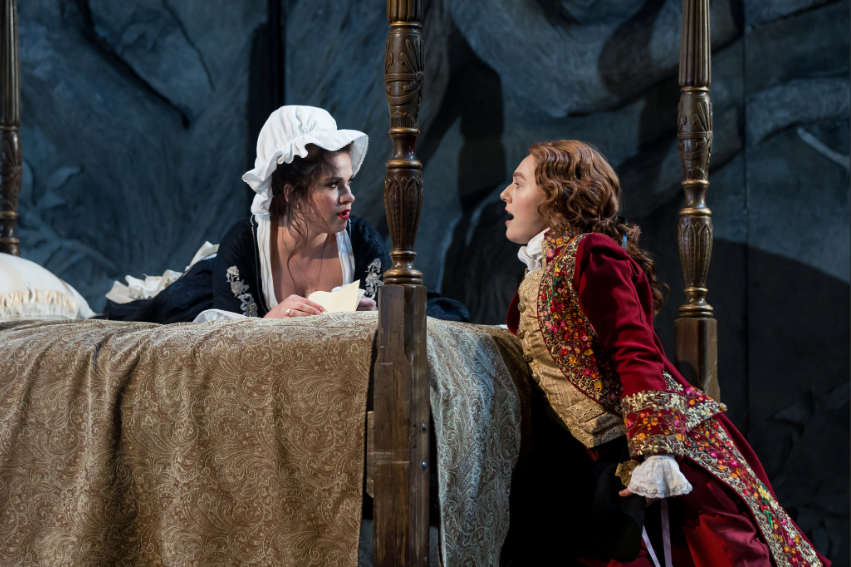
When a mirror isn't available, you need a lover to see yourself and learn who you are. As Cherubino sings in his brilliantly paired arias, he doesn't know who he is or what he's doing anymore; but perhaps the ladies, who know what love is, can teach him. All personal growth in this opera is accomplished through the mechanism of love.
Bartolo and Marcellina are transformed when they finally acknowledge the love that connects them to each other and to Figaro. Despite the cooling of their original ardor, the Count and Countess need each other desperately. Figaro is only Figaro because Susanna forces him to stay on top of his game. And without Figaro's jealousy and mistrust, Susanna would never sing her Act Four love song. Indeed, it's a ruse, but simultaneously the most sincere love music in the opera, and her one opportunity to figure out who she really is.
Forgiveness Makes The World A Great Good Place.
Dr. Bartolo was the villain of this opera's prequel, The Barber of Seville. When he first comes onstage in The Marriage of Figaro, he still hasn't forgiven Figaro, the Count, and Rosina for getting the better of him: "Forgiveness is for cowards," he sings. But he learns better. The Marriage of Figaro is an unusually sunny piece: it has conspicuously few moments of darkness or minor keys. It's crucial, final moment of forgiveness makes this opera's extreme happiness possible. In the context of the plot, it may be possible to dispute the wisdom of that ultimate act of forgiveness. But Mozart's music for that scene lifts us out of the plot. None of its twists and turns matter anymore; what matters now, and we hear it, is that the spring of love will never run dry.
God Must Experience Creation As An Ensemble Comedy.
None of the characters in The Marriage of Figaro really understands everything that happens on this exhausting, baffling, wonderful day. But we in the audience do. The clockwork brilliance of Beaumarchais's plot, the luscious lines of Lorenzo Da Ponte's verse, and Mozart's effortlessly perfect music combine to create an adorably entertaining whirligig. We'll never get tired of winding up this toy and playing with it.
This opera offers a bliss that can only be described as divine. Don't you think that's what God feels when smiling down upon creation, watching our lives, and listening to the song of all our hearts?
I just hope we put on half so good a show.